RV Storage and Off-Season Care: The Complete Guide
Proper RV storage and off-season care is essential for protecting your motorhome or towable camper from structural degradation, costly water leaks, and battery failure during extended periods of inactivity. By taking a proactive approach to winterization, climate control, and mechanical maintenance, you ensure your RV remains in prime condition and ready for your next road trip.
Whether you park your rig in coastal North Carolina or store it through harsh freezing temperatures, following a structured winterization routine saves thousands of dollars in potential repairs. In this chapter of our RV ownership guide, we break down the fundamental practices necessary to safeguard your motorhome, travel trailer, fifth wheel, or toy hauler through every season.
The 5 Pillars of RV Storage & Off-Season Care
To preserve your camper's structural integrity, plumbing systems, and electrical components, off-season care must address five crucial focus areas. Skipping any single pillar can lead to hidden damages that surface only when you prepare for your spring maiden voyage.
1. Moisture Control & Humidity Management
Humidity is an invisible threat to any recreational vehicle during long-term storage. High internal humidity causes mold, mildew, wood rot, and upholstery deterioration, especially in humid environments like coastal North Carolina.
- Drain All Water Lines: Drain your fresh water tank, low-point drains, and hot water heater completely. Pump non-toxic RV antifreeze through all plumbing lines unless storing in a temperature-controlled indoor facility.
- Utilize Dehumidifiers & Absorbents: Place desiccant tub dehumidifiers or active electric dehumidifiers inside the living area to maintain relative humidity below 50%.
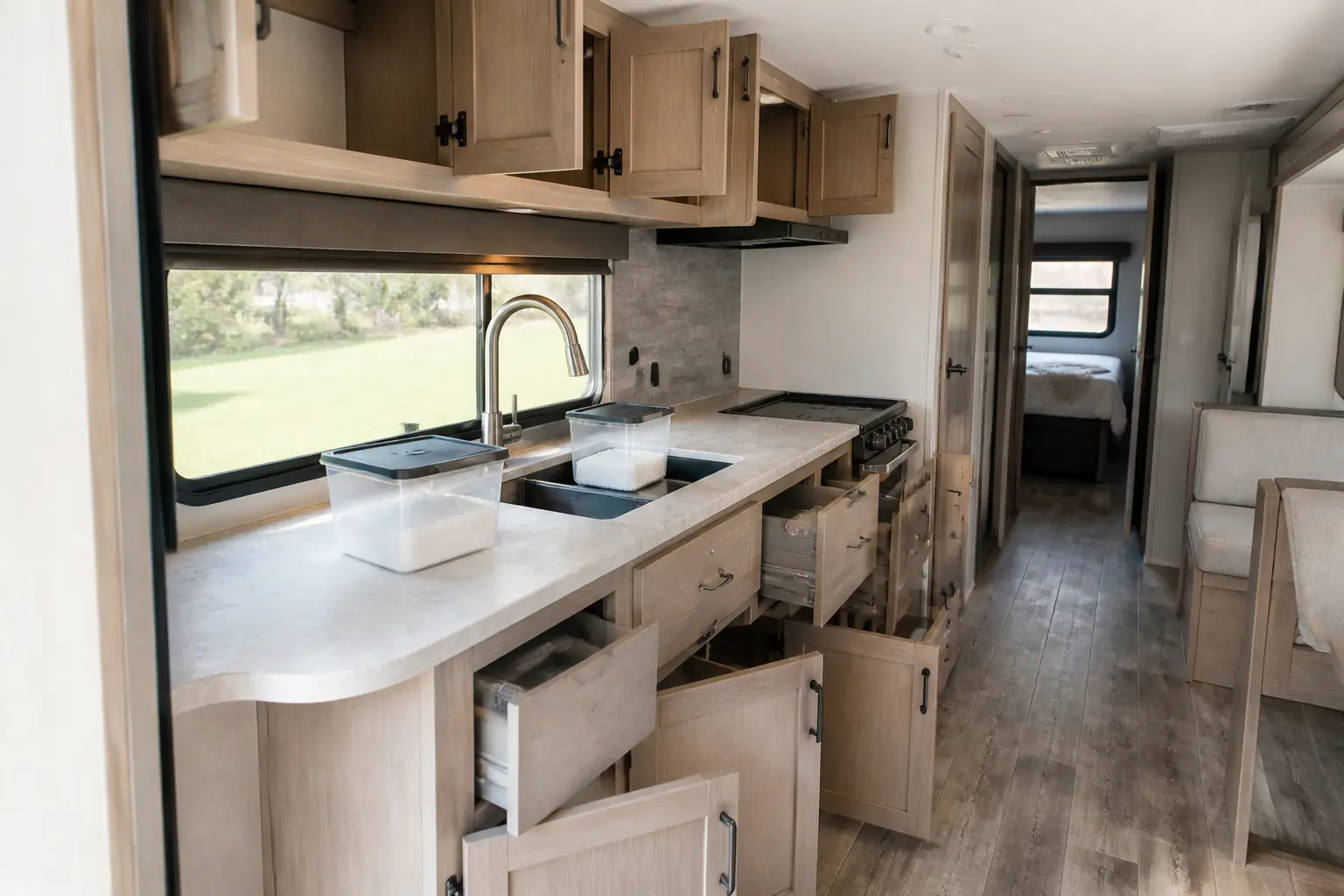
- Improve Air Circulation: Leave interior cabinet doors, wardrobes, and refrigerator doors propped open to allow continuous airflow and prevent stagnant air pockets.
- Inspect Window & Roof Seals: Inspect exterior lap sealant and silicone beads around vents, air conditioners, and slide-outs before parking for the season.

2. Pest & Rodent Prevention
Mice, insects, and birds seek warmth and shelter inside stored RVs during colder months. Unchecked pests can chew through wiring harnesses, PEX piping, and cushion fabric in a matter of weeks.
- Deep Clean Interior Surfaces: Remove every trace of food, crumbs, and pantry goods. Vacuum carpets and wipe down countertops with disinfectant.
- Seal Access Points: Inspect the underbelly, frame penetrations, and utility ports. Seal gaps with brass wool or spray foam insulation.
- Deploy Natural Repellents: Place peppermint oil sachets, cedar blocks, or commercial pest deterrents around slide seals, storage bays, and tires.
- Avoid Edible Baits Indoors: Never use food-based traps or poison inside the RV, as these attract pests into the vehicle before killing them.
3. Battery Health & Electrical Maintenance
Deep-cycle RV batteries naturally self-discharge over time. Leaving batteries connected during storage causes complete discharge, freezing, or permanent cell capacity loss.
- Disconnect Battery Cables: Turn off the master battery disconnect switch or disconnect the negative terminal cable to eliminate parasitic power draws.
- Maintain Fully Charged State: Charge lead-acid and AGM batteries fully before storage. Parasitic loads can drain a battery within 30 days if left unmonitored.
- Use Smart Trickle Chargers: Connect a multi-stage smart charger or maintainer, or remove batteries entirely and store them on a workbench in a climate-controlled area.
- Solar Maintenance Chargers: Roof-mounted solar trickle chargers can keep house batteries topped off if stored outdoors under direct sunlight.
4. Tire Preservation & Suspension Protection
Prolonged weight resting on stationary rubber causes flat spots, sidewall cracking, and dry rot. Supporting your RV's chassis properly keeps tires safe for highway travel.
- Inflate to Maximum PSI: Inflate all tires to the manufacturer's recommended cold pressure rating printed on the sidewall prior to parking.
- Park on Protective Pads: Park on plastic leveling blocks, rubber mats, or wooden boards rather than direct soil, asphalt, or wet concrete to prevent moisture transfer.
- Install UV Tire Covers: Use opaque, UV-resistant tire covers to shield tire rubber from sun exposure and atmospheric ozone degradation.
- Relieve Suspension Strain: On long-term storage, use stabilization jacks to support chassis weight, taking excess load off leaf springs and axle assemblies.
5. Exterior Protection & Protective Covers
Direct exposure to UV rays, acid rain, bird droppings, and tree sap gradually breaks down fiberglass gelcoats and rubber roof membranes.

- Wash and Wax the Exterior: Thoroughly clean the roof and sidewalls, then apply a high-grade RV carnauba or synthetic sealant wax.
- Use Breathable RV Covers: Select a custom-fitted, multi-layer breathable cover designed for your specific RV style. Never wrap your RV in non-breathable plastic tarps, which trap condensation inside.
- Exercise Slide-Outs & Seals: Clean slide-out rubbers and apply UV-protective seal conditioner to prevent sticking and cracking.
Comparing Off-Season Storage Options
Choosing the right location for off-season storage depends on climate, budget, and proximity to your home. Below is a breakdown of common storage options:
| Storage Type | Pros | Cons | Best For |
|---|---|---|---|
| Indoor Climate-Controlled Facility | Complete protection from weather, UV, freezing, and pests; low maintenance. | Highest monthly cost; requires off-site transportation. | High-end motorhomes & luxury travel trailers |
| Covered Outdoor Facility | Blocks sun damage, hail, and heavy rain; lower cost than indoor storage. | Exposed to ambient temperatures and outdoor pests. | Mid-range travel trailers, fifth wheels, & camper vans |
| Home Driveway / Open Lot | Free or low cost; convenient access for maintenance and packing. | Full exposure to weather; potential HOA or city parking restrictions. | Budget-conscious owners & frequent off-season campers |
Rex & Sons Storage Advantage
At Rex & Sons RVs, located in Castle Hayne, NC, we understand that off-season storage and care require professional precision. Serving Wilmington and coastal North Carolina since 1997, our family-owned dealership provides dedicated off-season service packages, professional winterization, roof resealing, and secure storage solutions for Forest River, Palomino, East to West, InTech RV, and Winnebago models.
Whether you need a full plumbing winterization, a multi-point seals and roof inspection, or high-quality breathable storage covers and battery maintainers from our parts department, our certified RV technicians are here to give you complete peace of mind.
What Comes Next?
Proper off-season care lays the groundwork for a stress-free return to the open road. Once winter passes, your next step is executing a thorough spring de-winterization and pre-trip safety checklist. In Chapter 24, we cover flushing antifreeze, sanitizing fresh water tanks, testing LP gas appliances, and inspecting safety gear before your first trip of the season.
Frequently Asked Questions
Should I leave my RV plugged into shore power all winter?
Plugging into 15-amp or 30-amp shore power is beneficial if your RV has a modern multi-stage converter charger that will not overcharge or boil battery electrolyte. If your RV lacks a smart charger, use a dedicated trickle maintainer instead.
How often should I check my stored RV during the off-season?
It is best practice to inspect your stored RV at least once every 30 days. Check moisture desiccant tubs, look for signs of pest activity, verify battery voltage, and visually inspect exterior covers and seals.
Can I use regular automotive antifreeze in my RV plumbing?
No, never use automotive antifreeze in an RV water system. Automotive antifreeze is toxic. You must only use non-toxic, pink RV/marine antifreeze designed specifically for potable water systems.
Do I need to cover my RV roof air conditioner?
Yes, installing a vinyl A/C shroud cover during storage prevents leaves, ice, water, and nesting insects from entering the rooftop unit while shielding plastic shrouds from UV degradation.
Ready to prepare your camper for the off-season? Trust the experienced team at Rex & Sons RVs in Castle Hayne, NC. Call our service department at (910) 793-2894 or our parts team at (910) 679-6522, visit us online to browse our latest RV inventory, or reach out through our contact page to schedule your off-season maintenance today!