
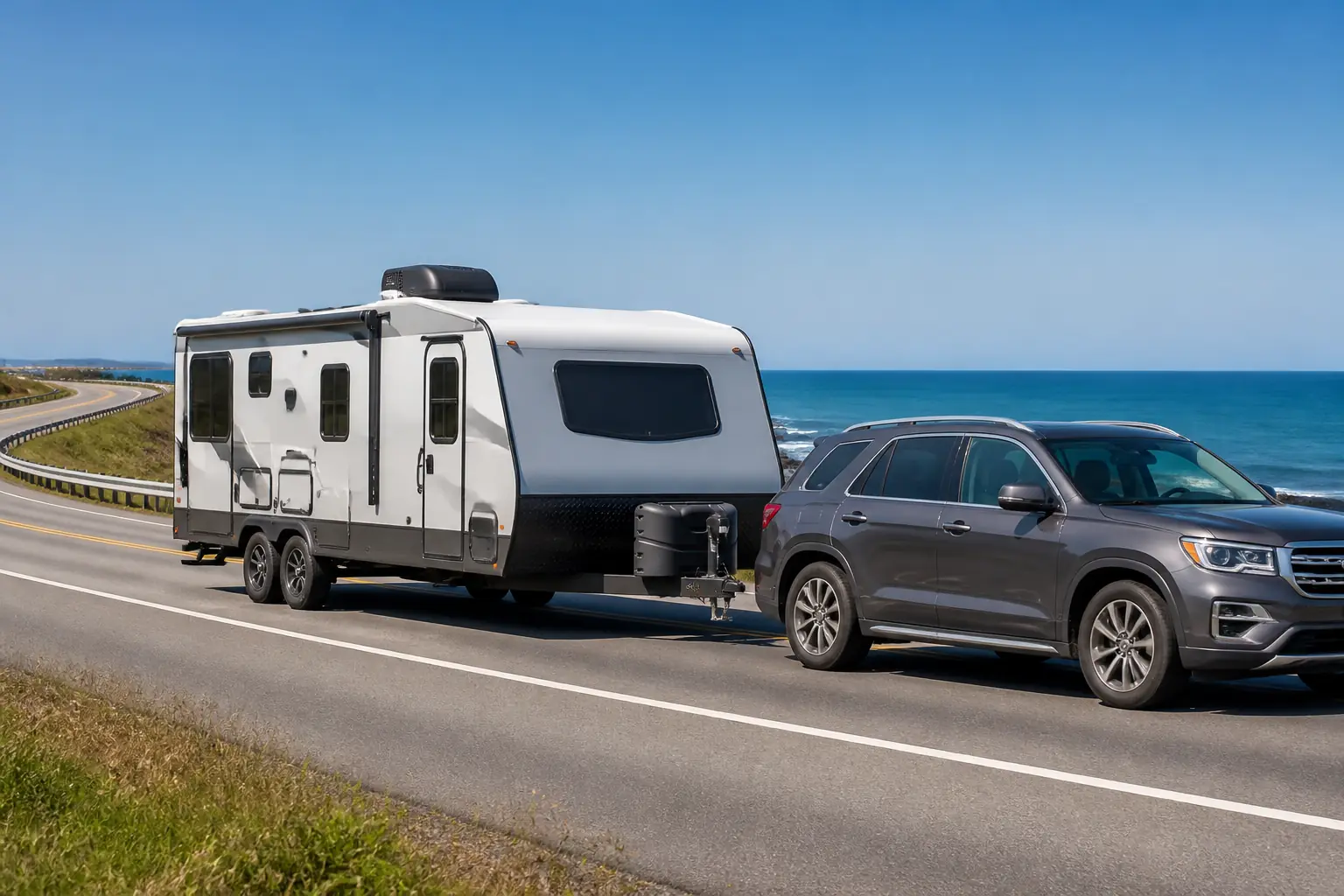
Understanding RV Safety Systems: 2027 RV Buyer's Guide Chapter 21
Modern RV safety systems combine advanced automotive technology with specialized onboard life-safety equipment to protect your family, tow vehicle, and rig on every journey. Whether you are navigating interstate wind gusts or sleeping soundly at a campsite, knowing how these active and passive systems function is essential for every RV buyer and owner.
Welcome to Chapter 21 of the 2027 RV Buyer's Guide, curated by the team at Rex & Sons RVs in Castle Hayne, North Carolina. In this chapter, we break down active driving and towing technology, emergency hazard detection, and routine safety inspection protocols into straightforward, practical guidance.

Active Towing and Driving Safety Technologies
Driving or towing a motorhome or travel trailer requires specialized systems designed to mitigate physical forces like sway, heavy momentum, and tire degradation. Modern recreational vehicles feature sophisticated electronic and mechanical safeguards that work continuously behind the scenes.
1. Electronic Stability Control (ESC) and Anti-Sway Systems
Trailer sway can occur due to sudden steering maneuvers, crosswinds along coastal highways, or passing semi-trucks. Modern Electronic Stability Control (ESC) systems automatically detect rotational motion and side-to-side oscillation.
- How It Works: Sensors mounted on the trailer axle monitor lateral movement. When instability is detected, the system selectively applies individual trailer brakes to pull the trailer back into alignment with the tow vehicle.
- Key Benefit: Corrects dangerous sway scenarios faster than human reaction time without requiring driver intervention.
2. Tire Pressure Monitoring Systems (TPMS)
Tire blowouts are among the leading causes of highway RV accidents. A dedicated RV Tire Pressure Monitoring System provides real-time data directly to the driver's display panel or mobile application.
- Continuous Pressure Tracking: Monitors PSI levels across all tire positions, including tow vehicle and trailer tires.
- Temperature Warning Alerts: Detects abnormal heat buildup—often an early sign of bearing failure, under-inflation, or dragging brakes.
- Rapid Leak Detection: Triggers immediate audible alerts if pressure drops suddenly while driving.
3. Integrated Braking Systems & Auxiliary Brake Controllers
Stopping a rig weighing several tons requires seamless synchronization between the tow vehicle and the trailer. Proportional brake controllers use inertial sensors to deliver smooth, precise braking power equal to the tow vehicle's deceleration rate.

Onboard Environmental and Life Safety Systems
Once parked, safety priorities shift from road dynamics to internal living environments. Modern RVs feature integrated monitoring modules designed to detect invisible hazards before they pose a risk to your family.
System Overview: Onboard Environmental Detectors
Propane (LPG) Leak Detection System
- Placement: Floor level (Liquefied Petroleum Gas is heavier than air and settles near the floor).
- Function: Continuously measures ambient gas concentrations.
- Action: Sounds a high-decibel alarm and, on advanced rigs, triggers an automated solenoid valve to shut off propane flow at the tank cylinder.
Carbon Monoxide (CO) & Smoke Alarm System
- Placement: Ceiling or high wall level (heat and carbon monoxide rise).
- Function: Dual-sensor detection for combustion particles and toxic, odorless carbon monoxide gas generated by furnaces, generators, or campfires.
- Action: Emits audible multi-tone alarms distinguishing between fire smoke and carbon monoxide accumulation.
Emergency Escape & Fire Suppression System
- Components: Dedicated egress exit windows with quick-release red latches and strategically placed Class B:C or A:B:C fire extinguishers.
- Function: Provides rapid secondary evacuation routes from bedroom quarters and immediate response capability for electrical or grease fires.
Comparison of Core RV Safety Systems
| Safety System | System Category | Primary Protection Hazard | Recommended Service Schedule |
|---|---|---|---|
| Electronic Stability Control (ESC) | Active Towing Safety | Severe trailer sway and rollover risk | Inspect wiring & sensor calibration annually |
| Tire Pressure Monitor (TPMS) | Active Towing Safety | Blowouts, under-inflation, hub overheating | Check sensor batteries & PSI before every trip |
| Propane (LPG) Detector | Environmental / Life Safety | Combustible gas leaks, explosion hazard | Test alarm monthly; replace unit every 5 years |
| Carbon Monoxide Detector | Environmental / Life Safety | Silent CO poisoning from generator/furnace | Test monthly; replace internal batteries yearly |
| Emergency Egress Windows | Passive Life Safety | Entrapment during internal emergency | Inspect rubber seals & operate latches quarterly |
Frequently Asked Questions
How often should I replace onboard RV safety detectors?
Most propane (LPG) and carbon monoxide detectors in RVs have an operational lifespan of 5 to 7 years. Most units feature an end-of-life chip that will chirp continuously when replacement is required. Always check the manufacture date stamped on the back of the detector.
Do travel trailers come with automatic braking if disconnected while driving?
Yes. Towable RVs equipped with electric brakes feature a emergency breakaway system. A steel cable connects from the trailer pin to the tow vehicle frame. If the trailer separates from the hitch, the cable pulls the pin, engaging the trailer's onboard 12V battery to lock the electric brakes automatically.
Can I add Electronic Sway Control to an older travel trailer?
In many cases, yes. Aftermarket electronic sway control units can be retrofitted onto most dual-axle travel trailers with electric brakes to work alongside traditional weight-distribution hitches.
What is the most critical safety item to check before departing on a trip?
Tire pressure and lug nut torque are the two most critical pre-trip safety checks. Under-inflated tires generate excessive heat at highway speeds, which is the leading cause of catastrophic tread separation and blowouts.
Keep Your Family Safe with Rex & Sons RVs
Understanding and maintaining your RV's safety systems ensures every camping trip is filled with wonderful memories rather than unexpected stress. At Rex & Sons RVs, our family has been helping coastal North Carolina RVers travel with confidence since 1997. Whether you need an inspection on your current rig's brake system, a new TPMS installed, or advice on choosing a modern model packed with active safety technology, our friendly team in Castle Hayne is here to help. Give our sales team a call at (910) 793-2894, speak with our certified service department at (910) 679-6522, or browse our latest safety-equipped new inventory today!