
Tow Vehicle Matching: A Complete Guide to GVWR, GCWR, and Payload
Matching your tow vehicle to an RV requires understanding critical weight ratings to ensure safe handling, legal compliance, and reliable performance on the highway. By correctly calculating Gross Vehicle Weight Rating (GVWR), Gross Combined Weight Rating (GCWR), Payload Capacity, and Tongue Weight, you protect your family, truck drivetrain, and camper from unsafe overloading.
Understanding Towing Terminology and Weight Ratings
Before hitching up for a trip down US-17 or heading up toward the Blue Ridge Mountains, you must understand the key acronyms found on your truck's tire specification placard and your trailer's weight sticker.
Gross Vehicle Weight Rating (GVWR)
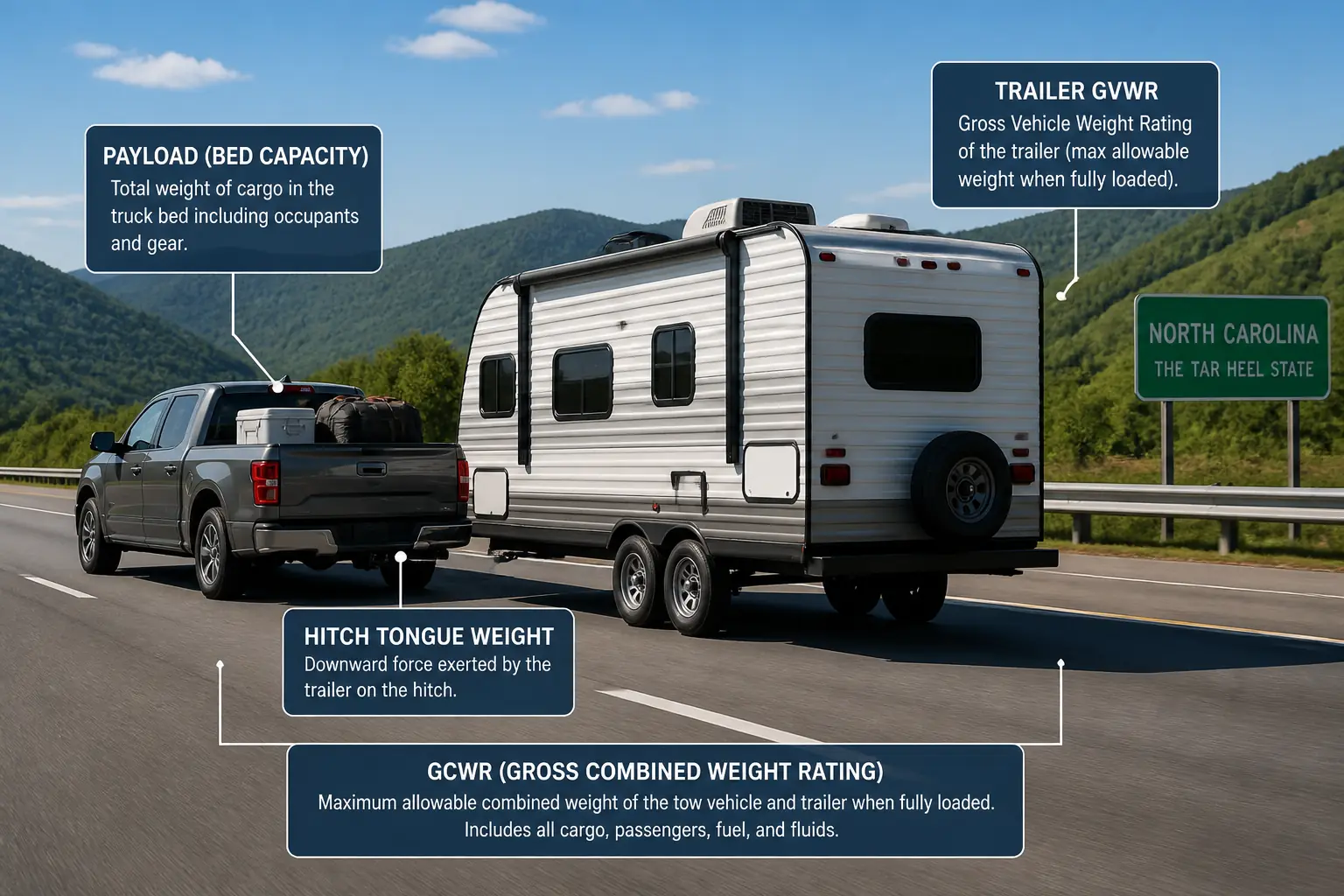
Gross Vehicle Weight Rating is the absolute maximum weight a specific vehicle or trailer can safely weigh on its own wheels when fully loaded. This includes the curb weight of the vehicle, all passengers, fuel, cargo, accessories, and the downward hitch weight exerted by a connected trailer.
Gross Combined Weight Rating (GCWR)
Gross Combined Weight Rating is the total allowable weight of both the fully loaded tow vehicle and the fully loaded trailer combined. Exceeding the GCWR puts extreme strain on your engine, transmission, brakes, and cooling system, which is especially hazardous when ascending or descending steep highway grades.
Payload Capacity
Payload capacity is the maximum weight your truck can carry in its cab and bed. Payload is often the first limit hit when towing a travel trailer or fifth wheel. Payload includes driver, passengers, aftermarket accessories (like running boards or bed covers), cargo, and the trailer's tongue weight or pin weight pressing down on the hitch.
Tongue Weight (Hitch Weight)
Tongue weight (TW) is the downward static force exerted by the trailer coupler onto the hitch ball of the tow vehicle. For conventional travel trailers, target tongue weight is typically 10% to 15% of the total loaded trailer weight. For fifth-wheel trailers, pin weight typically ranges between 15% and 25% of the total trailer weight.

Technical Breakdown: Weight Ratings & Calculation Formulas
Use this reference table to understand how each rating is defined and how to calculate available capacity before purchasing or loading your RV.
| Rating Acronym | Full Name | Definition | Calculation / Formula |
|---|---|---|---|
| GVWR | Gross Vehicle Weight Rating | Max safe weight of vehicle/trailer alone | Curb Weight + Max Payload |
| GCWR | Gross Combined Weight Rating | Max combined safe weight of rig + tow vehicle | Loaded Tow Vehicle + Loaded Trailer |
| Payload | Payload Capacity | Max weight added inside/on tow vehicle | GVWR - Actual Scale Curb Weight |
| TW / PW | Tongue Weight / Pin Weight | Downward hitch pressure on tow vehicle | 10%-15% (Travel Trailer) or 15%-25% (5th Wheel) of Loaded RV Weight |
| GAWR | Gross Axle Weight Rating | Max safe weight on front or rear axle | Scale Weight per Axle (Front / Rear) |
| UVW | Unloaded Vehicle Weight | Weight of RV as manufactured (dry weight) | Factory Baseline (Excludes Gear, Water, LP Gas) |
| CCC | Cargo Carrying Capacity | Max weight of gear, water, and propane | Trailer GVWR - Trailer UVW |
Step-by-Step Guide to Tow Vehicle Matching
Follow these five steps to accurately determine whether your truck or SUV can safely tow a specific travel trailer or fifth wheel.
Step 1: Locate Your Vehicle Placards
Open the driver's side door frame of your tow vehicle to inspect the tire and loading information placard and the safety certification label. Record the Payload limit, rear Gross Axle Weight Rating (GAWR), and vehicle GVWR.
Step 2: Calculate Real-World Available Payload
Subtract the weight of all occupants, pets, truck bed gear, and aftermarket equipment from the payload sticker number. The remaining figure is your available payload capacity for the trailer's tongue weight and hitch hardware.
Step 3: Estimate Loaded Trailer Weight
Never rely solely on a trailer's Unloaded Vehicle Weight (UVW or dry weight). Instead, use the trailer's Gross Vehicle Weight Rating (GVWR) as a safe baseline calculation, or add your expected cargo weight (typically 800 to 1,200 lbs) to the dry weight.
Step 4: Calculate Target Tongue Weight
Calculate 12% to 15% of the estimated loaded travel trailer weight (or 20% for a fifth wheel). Add 75 to 100 lbs for a weight distribution hitch. Confirm this total does not exceed your tow vehicle's available payload or hitch receiver rating.
Step 5: Apply a Safety Buffer (15% Margin)
To account for summer heat, mountain elevations, wind resistance, and unexpected cargo, maintain a 10% to 20% safety margin below your maximum towing capacity and payload capacity limits.
Local Considerations for Towing in Coastal North Carolina
Towing along coastal North Carolina presents unique conditions. Crosswinds along coastal bridges on US-17, US-74, and the Outer Banks demand stable tongue weight balance to prevent sway. Additionally, localized heat in summer strains transmission fluids during heavy towing. Matching your tow vehicle properly keeps your travel trailer tracking straight and prevents premature drivetrain wear.
Frequently Asked Questions
What happens if I exceed my tow vehicle's payload capacity?
Exceeding payload capacity causes dangerous rear suspension sag, misaligns headlights, lightens front-wheel steering control, reduces braking effectiveness, and increases risk of tire blowouts or mechanical failure.
Can I increase my towing capacity with airbag suspension or heavy-duty shocks?
No. Aftermarket airbags, helper springs, or heavy-duty shocks help level the vehicle stance and improve ride comfort, but they do NOT raise the manufacturer's official GVWR, GCWR, or payload limits.
Is dry weight or GVWR more important when shopping for an RV?
Trailer GVWR is much more important. Dry weight represents the trailer completely empty without battery, propane, water, or personal gear. Shopping based on GVWR ensures you never accidentally overload your tow vehicle.
How do I weigh my tow vehicle and RV rig accurately?
Visit a public certified automated truck scale (CAT scale) near Castle Hayne or along major interstate routes. Perform a three-pass weigh procedure (truck alone, truck and trailer with weight distribution engaged, and truck and trailer without weight distribution) to get exact axle weights.
Have questions about matching your vehicle to a new Forest River, Palomino, East to West, InTech, or Winnebago trailer? Contact the friendly team at Rex & Sons RVs in Castle Hayne, NC at (910) 793-2894 or explore our current inventory online to find lightweight travel trailers perfectly suited to your vehicle.