
Understanding RV Weights: A Complete Guide to Dry Weight, GVWR, CCC & Safe Towing
Understanding RV weights is essential for safe towing, protecting your tow vehicle’s engine, transmission, and brakes, and ensuring a smooth, stress-free drive across coastal North Carolina and beyond. Whether you are buying your first travel trailer or upgrading to a large fifth wheel, mastering key weight ratings like Dry Weight, GVWR, CCC, and Tongue Weight prevents dangerous overloading and keeps your family safe on every adventure.
At Rex & Sons RVs in Castle Hayne, NC, we want you to feel completely confident before hooking up your rig. In Chapter 16 of our RV Buyer's Guide, we break down every critical weight term, explain simple calculation formulas, share real-world loading scenarios, and provide a pre-trip weight checklist.

The 5 Key RV Weight Definitions Explained
Before hitching up your trailer or driving a motorhome, you need to understand the manufacturer weight ratings printed on your RV's official federal tire and loading specification label (typically located on the driver-side front exterior wall or inside a cabinet door).
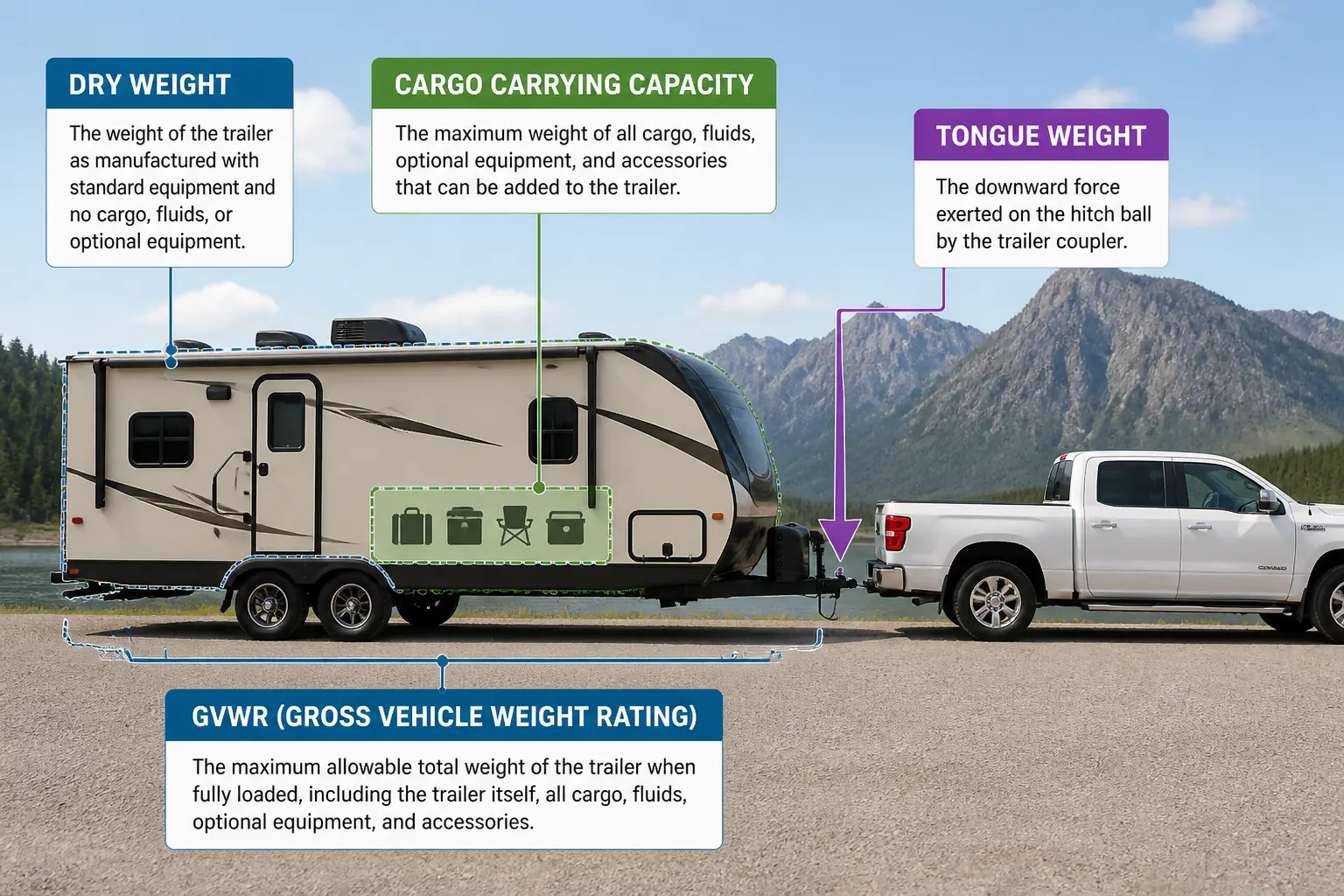
- 1. Dry Weight (Unloaded Vehicle Weight - UVW): The weight of the RV as built at the factory, including full fuel, engine oil, and coolants (for motorhomes). It does not include water, LP gas, dealer-installed accessories, passengers, or personal cargo. Important rule: Never purchase or tow an RV based solely on its Dry Weight, because your trailer will never be completely empty on the road.
- 2. Gross Vehicle Weight Rating (GVWR): The absolute maximum permissible total weight of the RV when fully loaded for a trip. This structural safety limit set by the manufacturer includes dry weight, cargo, water, propane, accessories, and tongue weight. Your fully loaded RV must never exceed its GVWR.
- 3. Cargo Carrying Capacity (CCC): The maximum allowed weight of all personal belongings, food, fresh water, LP gas, tools, camping supplies, and dealer-installed options that you can safely add to the RV.
- 4. Tongue Weight (or Hitch Weight / Pin Weight): The downward weight force that the trailer coupler exerts onto the hitch ball of your tow vehicle (or the fifth wheel pin in the truck bed). For travel trailers, target tongue weight is 10% to 15% of the total loaded trailer weight. For fifth wheels, pin weight is typically 15% to 25%.
- 5. Gross Combined Weight Rating (GCWR): The maximum allowable total weight of the fully loaded tow vehicle and the fully loaded RV added together. Exceeding GCWR overtaxes vehicle cooling systems, transmission, and braking capacity.
Mathematical Formulas for RV Weight Calculations
Use these simple mathematical formulas to calculate your RV's real-world capacities before packing for your next coastal trip:
Formula 1: Cargo Carrying Capacity (CCC)CCC = GVWR - Dry Weight (UVW) - LP Gas Weight
Formula 2: Fresh Water Weight CalculationFresh Water Weight (lbs) = Gallons of Water x 8.3 lbs
Example: 40 gallons of fresh water x 8.3 lbs/gal = 332 lbs consumed from your available cargo capacity.
Formula 3: Total Loaded RV Weight EstimationTotal Loaded Weight = Dry Weight + Gear Cargo + Water Weight + Propane Weight + Option Add-ons
Formula 4: Target Tongue Weight CalculationIdeal Tongue Weight (12% Target) = Total Loaded Trailer Weight x 0.12
Real-World RV Loading Examples & Scenarios
Scenario A: The Weekend Family Camping Trip
Consider a travel trailer with a Dry Weight of 5,000 lbs and a GVWR of 7,000 lbs. This trailer offers a theoretical maximum Cargo Carrying Capacity (CCC) of 2,000 lbs. Let's look at how fast that payload limit is used during a typical weekend getaway:
- Full Fresh Water Tank (30 gallons): 249 lbs
- Full Propane Tanks (two 20 lb LP cylinders filled): 40 lbs
- Deep Cycle Batteries (two Group 24 batteries): 110 lbs
- Pantry food, ice chest, cookware, and dishes: 150 lbs
- Bedding, towels, and clothing for 4 people: 120 lbs
- Outdoor gear (lawn chairs, grill, fire wood, bikes, rug): 250 lbs
- Dealer accessories (power tongue jack, weight distribution hitch system): 120 lbs
- Total Added Cargo: 1,039 lbs
In this scenario, total loaded RV weight equals 6,039 lbs. This stays safely under the 7,000 lb GVWR ceiling and leaves 961 lbs of buffer. However, if you travel with full gray and black wastewater tanks or heavy gear, that remaining buffer disappears quickly!

Comparison Table: Essential RV Weight Terminology
| Weight Term | Abbr. | What It Means | Why It Matters |
|---|---|---|---|
| Unloaded Vehicle Weight | UVW / Dry | Empty weight from factory without fuel, water, LP gas, or gear. | Baseline calculation starting point; never tow at dry weight. |
| Gross Vehicle Weight Rating | GVWR | Maximum allowable combined weight limit of loaded RV. | Exceeding causes frame stress, tire blowouts, and brake failure. |
| Cargo Carrying Capacity | CCC | Maximum total weight permitted for liquids, options, and gear. | Tells you exactly how many pounds of gear you can pack. |
| Hitch / Tongue Weight | TW | Downward load applied directly to tow vehicle hitch ball. | Too low causes trailer sway; too high squats vehicle rear axle. |
| Gross Combined Weight Rating | GCWR | Max combined weight rating for truck plus trailer combined. | Protects tow vehicle engine, transmission, and chassis integrity. |
Pre-Trip RV Weight & Loading Checklist
Follow this practical step-by-step checklist before hitting the highway out of Castle Hayne or Wilmington:
- Verify tow vehicle limits: Check your vehicle driver door jamb sticker for maximum Towing Capacity, Payload Capacity, and Rear Gross Axle Weight Rating (GAWR).
- Weigh heavy gear: Weigh heavy toolboxes, generators, and storage totes on a household scale before loading them into RV pass-through storage.
- Manage liquid loads: Travel with empty gray and black holding tanks whenever possible. Fill fresh water tanks at the campground rather than driving with full water weight.
- Follow the 60/40 balance rule: Distribute roughly 60% of heavy cargo weight forward of the trailer axles and 40% behind to maintain proper tongue weight and prevent highway sway.
- Measure tongue weight: Use a specialized tongue weight scale or a commercial CAT axle scale to confirm tongue weight sits between 10% and 15% of total loaded trailer weight.
- Check cold tire inflation: Check cold tire pressures for both truck and trailer. Under-inflated tires on a heavy camper are the primary cause of roadside blowouts.
- Adjust weight distribution spring bars: Ensure your weight distribution hitch and sway control system are properly tensioned according to tongue weight measurements.
Frequently Asked Questions
What is the difference between Dry Weight and GVWR?
Dry Weight (UVW) is the exact weight of the empty RV as manufactured at the factory without liquids, gas, accessories, or personal items. GVWR (Gross Vehicle Weight Rating) is the absolute upper weight ceiling allowed for the RV when fully loaded with all cargo, fluids, and options.
How do I calculate how much weight I can pack in my RV?
Subtract the RV's Dry Weight (UVW) and filled propane cylinder weight from the RV's GVWR. The remaining number is your Cargo Carrying Capacity (CCC). Always remember to deduct 8.3 lbs per gallon of fresh water if traveling with full tanks.
What happens if trailer tongue weight is too light or too heavy?
If tongue weight is too light (below 10%), the trailer becomes tail-heavy and prone to dangerous high-speed trailer sway. If tongue weight is too heavy (above 15%), it squats the tow vehicle rear axle, lifts front steering tires, and degrades braking performance.
Where can I weigh my loaded RV near Castle Hayne or Wilmington, NC?
You can weigh your tow vehicle and trailer combination at certified CAT Scales (Certified Automated Truck Scales) located at major truck stops along I-40, US-17, or US-74 near Wilmington and Castle Hayne, NC.
Let the Experts at Rex & Sons RVs Help You Tow Safely
At Rex & Sons RVs, family safety on the road is our top priority. Our experienced team in Castle Hayne, NC, is here to help you understand towing limits, choose the right weight distribution hitch, and match your tow vehicle to popular models from Forest River, Palomino, East to West, InTech RV, and Winnebago. Call our sales specialists at (910) 793-2894 or our parts and service department at (910) 679-6522. Browse our current lineup online at Rex & Sons RV Inventory or contact us today to schedule a personal weight and hitch consultation.